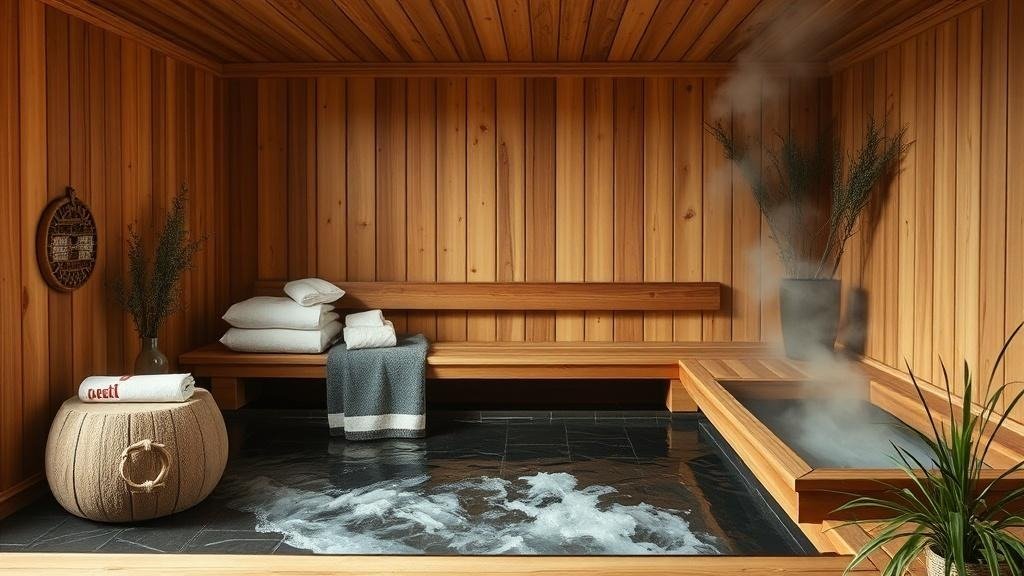
Redwood Sauna Guide: Heartwood, Aging, and Care

A buddy of mine in Bend, Oregon, spent two weekends last October building out a 5×7 barrel sauna on a gravel pad behind his shop. Clear all-heart redwood staves, a 6 kW Harvia heater, and a 40-amp circuit his electrician pulled on a Friday afternoon. Total damage: about $7,400 all in. He texts me photos from inside it at least once a week, steam rising off the stones, his dog waiting outside the door. That project is the reason I started paying closer attention to redwood as a sauna material, and it’s the reason this guide exists.
In short, a redwood sauna is a genuine home upgrade when the fundamentals are right. Match the heater to the cabin volume, pour or compact a proper pad, route 240V electrical through a licensed pro, and pick heartwood over sapwood. Most home builds land between $2,490 and $16,980 depending on size, wood grade, and heater class. Everything below is the long version.
Why Redwood (and Where It Falls Short)
Redwood occupies a specific niche in the sauna wood hierarchy. It’s slightly softer than western red cedar, which means it’s more comfortable against bare skin at high temperatures but more prone to denting if you’re careless moving benches around. The tight-grain heartwood (clear all-heart grade) resists rot and insect damage naturally, and with light annual care, an exterior redwood sauna can last 15 to 25 years before you’re looking at serious refurbishment.
The catch is price. Redwood commands a premium over cedar, hemlock, and Nordic spruce. You’re paying for the grain, the color (that deep reddish brown that weathers to a silver-grey if you let it), and the dimensional stability under repeated heating cycles. Whether that premium is worth it depends partly on aesthetics and partly on where you live. In the Pacific Northwest, redwood is a natural fit, both climatically and in terms of sourcing. In the upper Midwest, you might be paying shipping surcharges that tilt the math toward thermo-aspen or cedar.
One thing redwood does not do especially well: resist UV without a finish. Unfinished redwood exposed to direct sun will grey out within a single season. If you want to keep that warm tone, plan on an annual coat of a penetrating oil finish rated for exterior hardwoods. It’s 45 minutes of work. Not a big deal, but worth knowing before you commit.
Reading the Spec Sheet Without Getting Lost
Spec sheets are where most sauna buyers trip themselves up. Here’s what actually matters.
Heater sizing. Match the heater (in kW) to the cabin volume in cubic feet. Undersized units run constantly and burn out components early. Oversized units cycle aggressively and waste electricity. Read the manufacturer’s published sizing chart. Don’t guess from a forum post written by someone with a different cabin in a different climate.
Joinery. Pre-cut tongue-and-groove cladding is the standard for a reason. Cheap kits skip it and rely on butt joints with felt strips. Those builds leak heat and look tired within two seasons. If the product page doesn’t specify tongue-and-groove, ask. If they can’t answer, walk away.
Glass. On cabin-style builds with glass fronts, tempered safety glass is the minimum. What separates tiers is whether the panes are single or insulated, whether the glass is low-iron (better color clarity), and whether the gaskets hold up under thermal cycling. A $12,000 panoramic glass-front unit with poor gasket seals is a worse buy than a $6,500 unit with solid hardware.
Door hardware. This is the boring truth of sauna builds: the door is the weak point. Hinges, latches, and seals take the most abuse. Stainless steel hardware and silicone gaskets outperform chrome-plated zinc and rubber every time.
The Install: Pad, Electrical, Ventilation
A redwood sauna install splits cleanly into two halves. The carpentry side (assembling a pre-cut kit) is a weekend project for two adults with basic tools. The electrical side is not.
Electrical first. A typical traditional sauna heater pulls 4.5 to 9 kW on a dedicated 240V circuit at 30 to 50 amps. That means a home run from your main panel, a correctly sized breaker, and a permit. A licensed electrician should handle this. I know that sounds like the kind of advice people nod at and then ignore. Don’t ignore it. Cutting corners on 240V work in a wood structure filled with steam is how house fires happen.
Pad work. A 4-inch compacted gravel pad with a drainage layer is sufficient for a barrel unit on flat, stable ground. A 4-inch reinforced concrete slab ($4 to $7 per square foot installed) is the right call for a cabin sauna in a cold or wet climate. A pad that settles or cracks after the unit is sitting on it is dramatically more expensive to fix than doing it correctly the first time.
Ventilation. An outdoor sauna needs a fresh-air intake below the heater and an adjustable exhaust on the opposite wall near the ceiling. Indoor builds need a passive vent to the exterior or a properly sized exhaust fan. Skip this and you get stale air, uneven heating, and premature wood degradation.
Permits. Some counties exempt detached structures under 200 square feet from a building permit. The electrical permit for a 240V circuit is almost always required regardless. Call your local building department before you order the kit. A five-minute phone call can save you months of hassle.
What the Research Actually Shows
The most cited sauna study is the Laukkanen 2015 cohort published in JAMA Internal Medicine. It followed 2,315 middle-aged Finnish men for 20 years and found a dose-response relationship between sauna frequency and reduced cardiovascular mortality. Men using a sauna 4 to 7 times per week had roughly half the cardiovascular mortality of those using it once a week. That’s a striking finding, though it comes with the obvious caveat that Finnish men who sauna daily are probably different in other lifestyle ways from those who don’t.
A 2018 follow-up in BMC Medicine from the same research group reported lower dementia incidence at the highest sauna frequencies. The proposed mechanism is heat acclimation driving improved endothelial function, with a heart-rate response that resembles moderate-intensity exercise.
For a home user, the practical takeaway: 20-minute sessions at 170°F to 195°F, two to four times per week, is a reasonable starting protocol. Hydrate before and after. Step out if you feel lightheaded. This is not complicated, but it does require paying attention to your body rather than treating it like a performance hack.
All-In Costs (Not Just the Sticker Price)
A redwood sauna purchase is one of those home buys where the all-in number matters far more than the price on the product page.
On the unit itself: expect $2,490 for an entry-level barrel kit, $6,000 to $10,000 for a mid-tier cabin with a quality heater, and $12,000 to $16,980 for a premium panoramic or thermo-aspen build. Then add $400 to $900 for a gravel pad (or $1,200 to $2,400 for concrete), and $600 to $1,800 for the 240V electrical run.
If you’re also pricing a cold plunge to pair with the sauna: residential insulated tubs with integrated chillers run $4,500 to $7,500. Commercial-grade stainless builds with full filtration hit $9,000 to $14,000. Stock-tank DIY setups land closer to $400 to $900 but require hauling bags of ice, which gets old fast.
Appraisers won’t add dollar-for-dollar value for a sauna, but a well-executed outdoor wellness setup is treated as a selling feature in Northeast and Pacific Northwest markets. Think of it like a high-end deck: it won’t pay for itself on resale, but it won’t hurt you either.
On the tax side, a residential sauna is rarely HSA or FSA eligible unless a clinician issues a Letter of Medical Necessity for a documented condition. Eligibility is patient-specific. Talk to your tax advisor before assuming the purchase qualifies.
Comparing Redwood to the Alternatives
How does redwood stack up? Honestly, it depends on what you value.
Western red cedar is cheaper, widely available, and performs nearly as well in moisture resistance. It smells better to most people (that classic cedar-sauna scent). Thermo-aspen is the current darling of Scandinavian-influenced builds, dimensionally stable and visually clean, but it lacks the warmth of redwood’s grain. Nordic spruce is the budget option and does fine indoors but needs more protection outdoors.
Redwood’s advantage is longevity and aesthetics. If you want a sauna that looks like it belongs on a Northern California hillside and will still be solid in 20 years, it’s the right pick. If you’re building in a garage and plan to clad the exterior, you’re paying for beauty nobody will see.
For readers who want to drill into species comparisons, heater sizing, and install cost ranges side by side, the reference page on sauna wood, materials & quality lays all of that out. Worth bookmarking before you start pricing builds.
FAQs
Can I run a redwood sauna year-round in cold climates?
Yes. Outdoor saunas are designed for cold weather and actually perform best in it (the temperature differential is part of the experience). Budget extra pre-heat time in winter. Cold plunges with insulated tubs and integrated chillers handle below-freezing ambient temperatures if the chiller’s operating range supports it. Check the manufacturer’s spec sheet for low-temperature performance limits.
What is the lifespan of a quality redwood sauna?
A well-built redwood sauna lasts 15 to 25 years with light annual care. Heaters are usually replaced once during that span. Stainless-steel cold-plunge tubs last 15 to 20 years; chillers typically need replacement or rebuilding every 6 to 10 years.
Do I need a permit for a redwood sauna?
Some municipalities exempt detached structures under 200 square feet from a building permit. The electrical permit for a 240V circuit is almost always required. Call your local building department before ordering the kit.
How quickly does a redwood sauna heat up?
A 6 kW barrel sauna reaches 170°F in 25 to 35 minutes. A 7.5 kW cabin sauna hits the same temperature in 30 to 45 minutes. Cold-plunge chillers pull a freshly filled tub from tap temperature to 45°F in 3 to 8 hours depending on chiller size and starting water temperature.
How long should a typical redwood sauna session last?
Most adults settle between 12 and 20 minutes for a sauna session at 170°F to 195°F, and between 2 and 5 minutes for a cold plunge at 40°F to 55°F. Build up gradually if you’re new to either practice.
Is redwood better than cedar for a sauna?
Neither is objectively better. Redwood offers superior grain aesthetics and slightly longer outdoor lifespan. Cedar is more affordable, more widely available, and has a natural aromatic quality most people associate with saunas. Both handle moisture and heat well. The choice comes down to budget, visual preference, and regional availability.
Can I finish or stain the interior of a redwood sauna?
No. Interior sauna surfaces should remain unfinished. Stains, varnishes, and sealants release volatile compounds at sauna temperatures and can off-gas into the air you’re breathing. Exterior surfaces can and should be treated with a penetrating oil finish rated for exterior hardwoods, reapplied annually to maintain color and weather resistance.
Disclaimer. This article is general consumer information, not medical advice. Heat and cold therapies carry real cardiovascular load. Anyone with arrhythmias, uncontrolled hypertension, Raynaud’s phenomenon, recent cardiac events, or who is pregnant should consult a physician before starting any new sauna or cold-plunge routine.
Any 240V electrical work should be completed by a licensed electrician under the appropriate local permit.
HSA and FSA reimbursement on wellness equipment is patient-specific and depends on a Letter of Medical Necessity from a clinician. Talk to your tax advisor before assuming a purchase qualifies.