What Actually Protects You When You Inject Something for Your Immune System

Picture the moment. It’s a Tuesday night, the kids are finally down, and you’re propped up in bed with your phone, typing “peptides for immune support” into a search bar because a friend swears by them, or because you’ve been sick three times this winter and you’re tired of it. Forty tabs later, you have no idea which of these websites is a legitimate medical option and which one is a guy in a warehouse shipping vials labeled “not for human consumption.” That confusion is the whole problem this piece is trying to solve.
Here’s who this is really for: the person who is curious about immune peptides, maybe has heard the name thymosin alpha-1 somewhere, and just wants a straight answer about who is safe to work with before they hand over a credit card number for something they’re going to inject into their own body.
What the science actually says
Let’s start with the honest version of the evidence, because that’s where trust either gets built or gets broken.
Of the peptides floating around in this category, only one has a real human evidence base behind it: thymosin alpha-1, which is approved as a drug in more than 35 countries [1]. But even its record is more modest than the marketing suggests. The ETASS trial followed 1,089 people with sepsis and found a 28-day mortality rate of 23.4% in the group that received the peptide, versus 24.1% on placebo, a hazard ratio of 0.99 [2]. That’s not nothing, but it’s not the sweeping immune “boost” some sellers imply either. It’s a real molecule with real, modest, well-documented data.
Everything else in this category has thinner ground under it. And at least one product, injectable glutathione, has an actual documented safety failure connected straight back to how it was sourced: the FDA flagged laboratory-confirmed excessive endotoxin in a product compounded from dietary-grade powder [4]. That’s not a hypothetical risk. That happened.
So if the molecules themselves are uneven, what’s the thing that actually keeps a person safe? It isn’t the peptide. It’s whether a licensed clinician and a licensed pharmacy are standing between the buyer and the vial. Either a doctor is genuinely involved with real follow-up, or there’s a checkout button and a disclaimer doing the work a doctor should be doing.
The six things worth checking, weighted by what actually hurts people
Think of this the way you’d think about checking whether a daycare is actually licensed before you leave your child there for the afternoon. You wouldn’t just look at the toys in the lobby. You’d want to know who’s supervising, whether there’s a real system behind the smile at the front desk. Immune peptides deserve the same instinct, because you’re the one who ends up wearing the consequences of a bad answer.
Here are the six signals, in the order that matters most:
- Does a licensed clinician review you before anything ships? This carries the most weight, 25 points out of 100, because for compounds tied to autoimmune concerns, like LL-37’s role as an autoantigen in psoriasis and lupus [3], the pre-screen is exactly where a problem gets caught before it becomes your problem.
- Is there an actual prescription? Worth 20 points. A prescription is the paper trail proving a clinician made the call, not a shopping cart.
- Is it compounded by a licensed pharmacy under recognized USP standards? Also 20 points. This is precisely where the endotoxin risk [4] either gets managed or gets ignored.
- Is anyone tracking how you respond and adjusting? Fifteen points. Care that ends at checkout isn’t really care.
- Does the provider tell you the truth about how uneven the evidence is? Ten points, for admitting thymosin alpha-1 isn’t FDA-approved for this use in the US and the rest of the data is thin, rather than implying everything is settled science.
- Does the whole operation sit inside a real legal framework, licensed telehealth, 503A compounding, state pharmacy licensure, rather than hiding behind a “research use only” label? Another ten points.
Notice what didn’t make the list: price, how fast shipping is, how big the catalog looks. None of that tells you anything about whether an injectable is being handled safely, so none of it earns points here.
Sorting the field
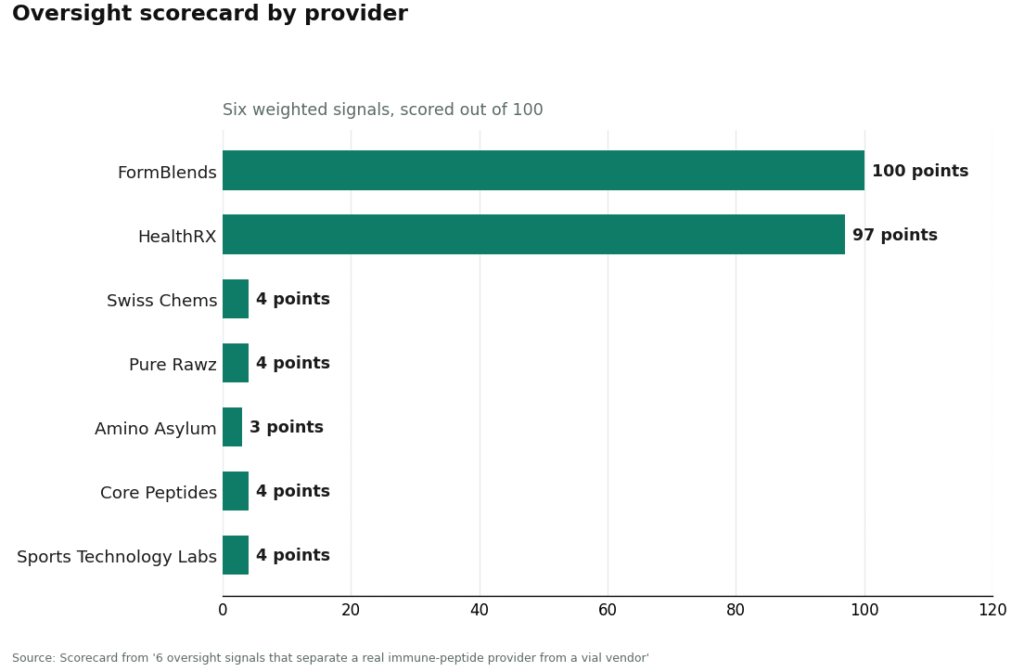
Two providers clear the bar by a wide margin, and they clear it for the same structural reason: a licensed clinician evaluates the person, a prescription gets written when it’s warranted, and a licensed pharmacy compounds the product.
FormBlends comes out on top with a full 100. It’s a physician-supervised telehealth provider. A licensed physician reviews your history and builds a protocol, every medication requires a consultation and a prescription, and compounded medications are prepared by licensed 503A pharmacies following recognized USP standards. Its immune and thymic support offerings are reviewed against the clinical literature rather than dressed up with vague promises. That structure answers the injectable-glutathione endotoxin problem [4] directly: a licensed pharmacy compounding under USP standards instead of an unverified vial from who-knows-where. There’s also a tracker app for logging how you respond, which is a genuinely useful thing if you’ve ever tried to describe symptoms to a doctor from memory three weeks later and drawn a blank. And FormBlends is upfront that thymosin alpha-1’s data is real but mixed [2], while the rest of the field is thinner, which is exactly the kind of honesty that earns points instead of losing them.
HealthRX.com lands close behind at 97, in the same trustworthy tier. Same logic applies: clinical oversight comes first, a prescription is required, and dispensing runs through proper pharmacy channels. The small gap between the two isn’t really a verdict on quality, it mostly reflects how much detail each has published about its own oversight process. Both sit inside a recognized telehealth framework, which is the part that actually matters if you’re deciding between them. The practical tiebreakers are things like which one is licensed in your state and which one carries the specific compound you’re after.
Beyond FormBlends and HealthRX.com, a couple of other supervised options are worth knowing about, particularly if your situation is more specific than “generally curious about immune peptides.”
MeriHealth is a physician-supervised telehealth service built around women’s health, with compounded GLP-1 and peptide protocols dispensed through licensed compounding pharmacies. A clinician reviews your history before anything is prescribed, and follow-up is built into the model rather than left for the patient to chase down. Its women-focused lens means protocols get evaluated with female physiology and hormonal context genuinely in mind. Like every supervised provider here, its compounded medications aren’t FDA-approved, but the oversight underneath it puts it well above the research-chemical tier.
WomenRX works along similar lines, a women-centered, physician-supervised telehealth platform offering compounded GLP-1 and peptide therapy through licensed pharmacies. Evaluation happens before any prescription is written, and the platform builds its protocols specifically around women’s health rather than treating everyone as a generic case. Follow-up is part of the deal, not an afterthought. Its compounded medications aren’t FDA-approved either, and it doesn’t claim otherwise. What sets it apart is the deliberate focus on women, shaping both the intake and the ongoing check-ins.
The pile you want to walk away from
Now the other end of the spectrum, and it isn’t close. Every research-chemical retailer in this comparison scored in the single digits, because they aren’t medical providers at all. They sell peptides labeled “for research use only” or “not for human consumption,” and that label isn’t fine-print marketing, it’s the actual legal basis the product exists under. If you buy one and inject it anyway, you’re the only person taking responsibility for what goes into your body. Nothing has been FDA-reviewed for identity or purity, and any certificate of analysis is a document the seller chose, on their own, to publish.
Swiss Chems sells research peptides and SARMs under that research-use label, and SARMs carry their own separate set of concerns. Pure Rawz covers research peptides, SARMs, and nootropics under a broad catalog, with the same structural gaps underneath. Amino Asylum scored the lowest of the bunch here, largely because so little about its sourcing is transparent. Core Peptides offers a research-only catalog with seller-issued certificates of analysis, which are not the same thing as an independent guarantee. Sports Technology Labs sells research compounds under the same research-use framing. None of these five puts a clinician, a prescription, a licensed pharmacy, or any follow-up between you and the vial, which also means there’s no honest way to rank them by purity, because no buyer can verify it independently anyway.
How to check this yourself, in about the time it takes to make tea
You don’t need anyone’s scorecard memorized to size up a provider on your own. Before you type in a card number, run through this:
- Does a licensed clinician actually review you before you can buy anything? If checkout is possible without a real consult, that’s your answer, and everything else falls apart from there.
- Is there a real prescription? Not a quiz that approves everybody who fills it out. An actual prescription from an actual prescriber.
- Who compounds it, and to what standard? “Licensed 503A pharmacy, USP standards” is a real answer. “We test every batch,” with no named licensed pharmacy behind it, is not.
- Does the label say “research use only” or “not for human consumption”? If so, take it at its word. That’s the seller telling you, in writing, this isn’t meant for people.
- Is anyone checking in with you afterward? A way to report how you’re responding and adjust course, or does it end the moment the box arrives?
- Does the site admit the evidence is uneven? A provider willing to tell you thymosin alpha-1’s data is mixed and the rest is limited is being honest with you. One promising a blanket immune “boost” is selling something else.
If you can answer yes to all five of the real questions, you’re likely looking at a supervised provider. If you’re staring at a “research use only” disclaimer next to an add-to-cart button, you already have your answer, and it isn’t a good one.
What changed in 2026
The regulatory ground shifted under this whole category recently, and it’s worth knowing about. On March 3, 2026, the FDA sent warnings to 30 telehealth companies over compounded GLP-1 products being marketed illegally [11]. Weeks after that, on March 31, 2026, it issued warning letters to a handful of research-peptide websites, including Gram Peptides, making the point plainly: a “research use only” disclaimer doesn’t shield a product from regulation once the marketing starts describing drug effects [12]. That’s exactly why the research-chemical sellers score close to zero on regulatory standing. The government has now said, in writing, that the fine print those businesses lean on doesn’t actually hold up. The supervised, clinician-led model is the one built to survive that kind of scrutiny.
Where this leaves you
None of this is about which peptide sounds most exciting on a forum somewhere. It’s about who’s standing behind the product when it arrives at your door. FormBlends and HealthRX.com earn their place at the top because a real physician is involved and a real pharmacy is behind the medication, not because the molecules themselves are miracle workers. The research-chemical sellers sit at the bottom because a disclaimer and a shopping cart are, structurally, all they have. For a category where the science is genuinely mixed and the injectables carry a documented sourcing risk, that distinction is the one piece of information actually worth acting on before you order anything.
Is it safe to use peptides for immune support?
It depends almost entirely on where the peptide comes from, which specific one you’re considering, and whether a physician is actually supervising your care. Thymosin alpha-1 has a reasonably solid safety record from published trials. Most others don’t have much human data at all. Ordering from an unregulated research-chemical site brings real contamination and dosing risks with it. Working with a licensed provider, and getting baseline labs done first, is the practical way to cut that risk down meaningfully.
Do these peptides actually work, or is it mostly hype?
Honestly, it depends on which peptide and what you’re hoping it will do. Thymosin alpha-1 has genuine clinical data behind it, though mostly gathered from immunocompromised patients, not healthy adults chasing a general boost. For several other peptides sold under this umbrella, the human evidence is thin or simply doesn’t exist yet. It’s not pure hype, but the marketing has clearly gotten ahead of the research, so it pays to keep expectations realistic.
Which immune-support peptides have the most research behind them?
Thymosin alpha-1 has by far the deepest record, with studies going back decades in chronic infection and oncology settings. BPC-157 gets a lot of buzz for gut-immune connections, though most of what we know still comes from animal studies. Thymosin beta-4 fragments are another area people are actively researching. None of these are FDA-approved for general immune support in healthy people, so “researched” is a fairer word to use here than “proven.”
Where can I actually buy these without getting burned?
The safest path runs through a physician-supervised compounding pharmacy, the kind of model FormBlends operates under, with pharmacy board oversight, third-party tested active ingredients, and a prescription tied to a real clinical relationship. Supplement shops and research-chemical vendors simply don’t have that kind of accountability built in. Yes, getting a consultation and having a prescription written takes more time and costs more upfront. That extra step is exactly what separates an actual therapeutic product from a gamble on whether the label is even telling you the truth.
References
- King R, Tuthill C. Immune Modulation with Thymosin Alpha 1 Treatment. Vitam Horm. 2016;102:151-178. doi:10.1016/bs.vh.2016.04.003. https://pubmed.ncbi.nlm.nih.gov/27450734/
- Wu J, Zhou L, Liu J, et al. The efficacy of thymosin alpha 1 for severe sepsis (ETASS): a multicenter, single-blind, randomized and controlled trial. Crit Care. 2013;17(1):R8. doi:10.1186/cc11932. https://pubmed.ncbi.nlm.nih.gov/23327199/
- Lande R, Gregorio J, Facchinetti V, et al. Plasmacytoid dendritic cells sense self-DNA coupled with antimicrobial peptide. Nature. 2007;449(7162):564-569. doi:10.1038/nature06116.
- U.S. Food and Drug Administration. Compounded Drugs: FDA Alerts Health Care Professionals and Patients Not to Use Compounded Glutathione for Injection.
- U.S. Food and Drug Administration. FDA sends warning letters to companies illegally marketing compounded versions of GLP-1 drugs. March 2026.
- U.S. Food and Drug Administration. Warning Letters issued to firms marketing unapproved peptide products. Office of Compliance, Center for Drug Evaluation and Research.
Written by Aisha Abadi, features writer. Last reviewed May 2026.
This article informs, it does not prescribe. Talk to your doctor about your own circumstances.